Protecting Sylvan Lake: The Science Behind Our Recommended Wake Boat Zone
Protecting Sylvan Lake: The Science Behind Our Recommended Wake Boat Zone
New university research confirms what lake lovers have long suspected — and our new map shows exactly where responsible boating makes the biggest difference.
Sylvan Lake is a cherished treasure — a place where generations of families have swum, fished, paddled, and made memories that last a lifetime. Like any living ecosystem, our lake is also a place that deserves our care and respect. That's why the Sylvan Lake Association is sharing an important new tool: a science-backed map that identifies the Recommended Wake Boat Area — the portions of our lake where wake surfing and wakeboarding can be enjoyed with the least harm to the water, the shoreline, and everyone who shares the lake.

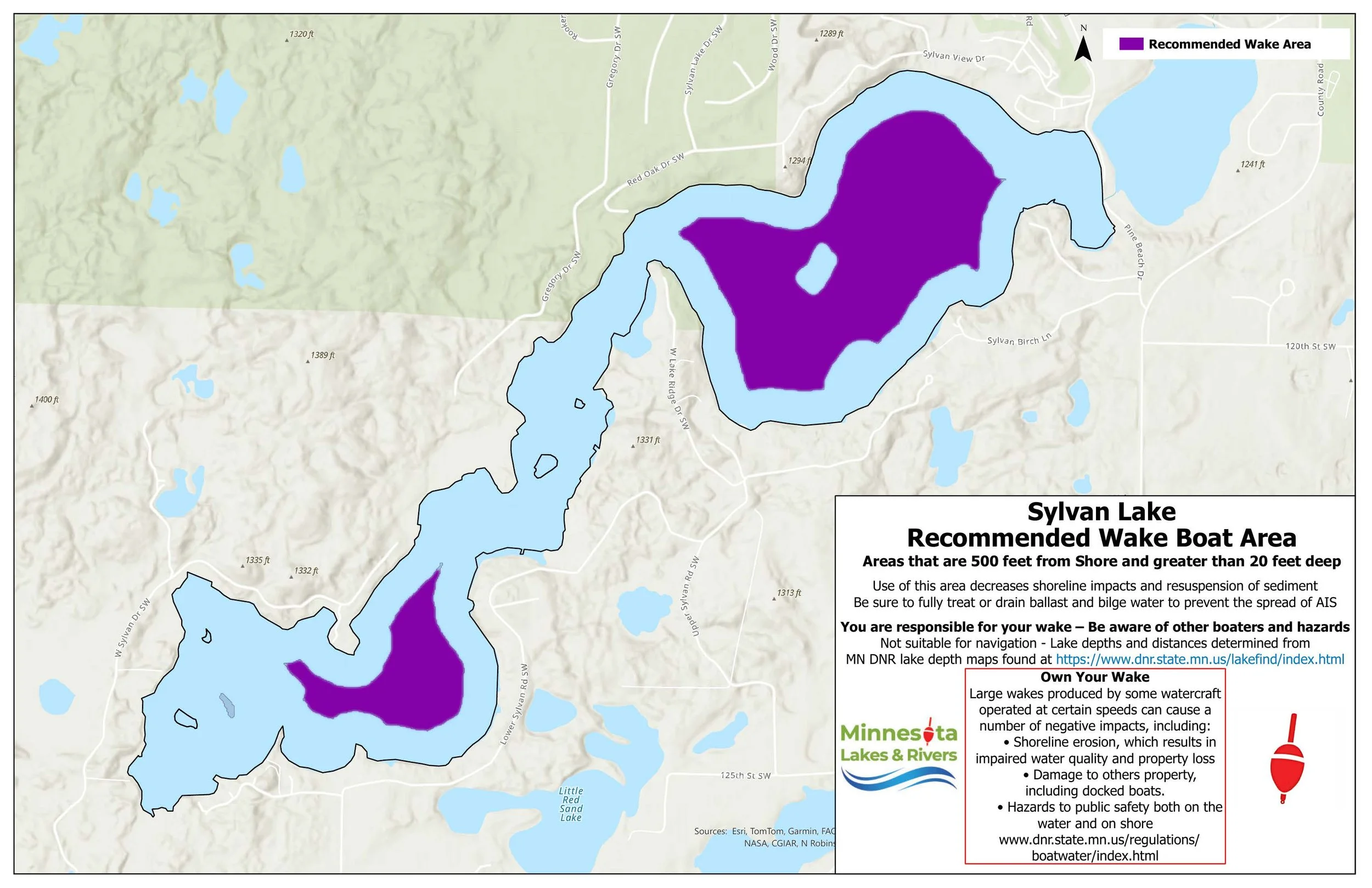
Sylvan Lake Recommended Wake Boat Area. The purple zones mark water that is at least 500 feet from shore and at least 20 feet deep — the two science-based thresholds that minimize environmental impacts from wake boating. Map data sourced from the MN DNR lake depth survey. Not suitable for navigation.
What the Science Tells Us
For years, lake associations across Minnesota raised concerns about the growing popularity of wake boats — purpose-built vessels that fill heavy ballast tanks with hundreds of gallons of water to create large, surfable wakes. In response, researchers at the University of Minnesota's St. Anthony Falls Laboratory launched a multi-phase field study to measure, with scientific rigor, exactly what these boats do to our lakes below the surface.
The study tested seven recreational powerboats over the 2022 and 2023 field seasons, deploying acoustic sensors to measure pressure and water velocity through the entire water column and at the lakebed. Researchers also collected sediment samples and tracked multiple water quality parameters. Their findings, published in the University Digital Conservancy in July 2025, are striking.
"You see a lot of turbulence, and you see the bottom sediments — sand, shells — being suspended in the water. You see vegetation, even root masses moving by the camera."
— Jeff Marr, Co-Author & Associate Director of Engineering, St. Anthony Falls Laboratory, University of MinnesotaWhile all motorized boats create some disturbance, wake boats operating in surf mode generate turbulence powerful enough to directly resuspend sediment from the lakebed. That may not sound alarming at first — but the consequences ripple through the entire ecosystem. Sediment is full of phosphorus, and when it's stirred up and suspended in the water column, it becomes available to fuel algae blooms that cloud the water, reduce oxygen, harm fish, and degrade the swimming and fishing experience that makes Sylvan Lake special.
Why 500 Feet from Shore — and Why 20 Feet Deep?
These aren't arbitrary numbers. The UMN's earlier wave study found that wake boat waves — which carry far more energy than those of a typical motorboat — require 400 to over 1,000 feet to dissipate to the energy levels of a standard recreational boat. Operating closer to shore means those powerful waves arrive at the shoreline still carrying enough force to erode banks, undercut tree roots, damage docks, and destroy the nearshore habitat that fish, waterfowl, and aquatic plants depend on.
The depth threshold is equally important. At 9 and 14 feet of water, researchers measured direct sediment resuspension from wake boats in surf mode. At 20 feet or greater, the turbulence generated by the hull, propeller, and ballast weight dissipates enough that sediment disturbance drops dramatically. For all other powerboats simply cruising or on plane, the researchers recommend a minimum of 10 feet of water.
As Jeff Marr put it simply: "For all motorized boats, simply being careful about where you steer your boat and avoiding shallow spots can make a huge difference."
The Hidden Threat: Aquatic Invasive Species
The environmental stakes extend beyond waves and sediment. Wake boats present a unique risk for the spread of Aquatic Invasive Species (AIS). Their ballast tanks — which hold hundreds of gallons of lake water to weight the hull — are not designed to be fully drained. On average, approximately five gallons of water remain in the system after draining. That water can harbor zebra mussels, milfoil fragments, and other invasive organisms that hitchhike from lake to lake, with potentially devastating consequences for native ecosystems.
Before You Hit the Water — Prevent the Spread of AIS
- Drain all water from ballast tanks, bilge, live wells, and bait buckets before leaving the boat launch.
- Remove any visible aquatic plants, animals, or mud from your boat, trailer, and equipment.
- Dry everything for at least five days, or rinse with hot (140°F) water if traveling between lakes quickly.
- Report suspected new AIS sightings to the MN DNR at 888-646-6367.
What This Means for Sylvan Lake
The map above identifies two zones on Sylvan Lake that meet both the 500-foot and 20-foot depth thresholds — one in the northern basin and one in the southwestern arm of the lake. These are the areas where wake boating can be enjoyed while keeping its impact on the broader lake community to a minimum.
This map was developed using depth data from the MN DNR Lake Finder and is intended as a recommended guide, not a legal regulation. Our goal isn't to tell you where you can't go — it's to show you where you can go and feel confident that you're doing right by the lake. The Sylvan Lake Association is proud to lead with science and community values rather than conflict.
We also want to acknowledge the many responsible wake boat owners on our lake who already practice courteous boating. Your awareness matters. Sharing this map with friends and guests who join you on the water is one of the most impactful things you can do.
The Bigger Picture
Minnesota's lakes are not just recreational assets — they are ecological systems that support biodiversity, filter water, sequester carbon, and underpin property values and local economies. The University of Minnesota researchers are now beginning a Phase Three of their study, examining how boat and wind waves affect nearshore plant communities — the very habitat that sustains fish spawning, filters runoff, and stabilizes banks. The science is evolving, and the Sylvan Lake Association will continue to monitor new findings and share them with our community.
In the meantime, the message from the research is clear: where you boat matters just as much as how you boat. Using the Recommended Wake Boat Area is a simple, voluntary action that protects the water quality, shoreline health, and shared enjoyment of Sylvan Lake for everyone — and for generations to come.
Own Your Wake — Be Part of the Solution
Download the map, share it with fellow boaters, and join the Sylvan Lake Association in keeping our lake healthy and beautiful for generations to come.
Download the Full Map (PDF) MN DNR Boating Regulations